

After decades of digitalization and automation, the banking and financial services industry is under pressure to answer a simple but weighty question: where do humans fit in future workforce plans?
Until a few years ago, this wasn’t even a question. Most institutions planned that:
- Branch staff would dwindle as consumers shifted toward digital channels
- Fraud specialists, AML analysts, compliance agents, relationship managers, data analysts, and other roles would grow in demand, augmented by technology.
Now even the demand for technical roles is less certain.
National banks, regional banks, community banks, and credit unions are all finding ways to incorporate AI into their operations. Though 60% of CEOs in an EY survey said they believed AI would maintain or increase headcount, that hasn’t yet materialized, especially with three of nation’s largest banks projecting workforce reduction.
This isn’t just a North American phenomenon. Banks across India, Vietnam, Germany, the UK, and other countries have reduced their headcount while making multi-year investments in AI and digital transformations.
So, what does this mean for the people still in and entering these institutions? Three questions cut to the heart of it: How is AI and automation being used in these organizations? Which skills are rising and which are becoming obsolete? How can institutions reskill workers to fill banking jobs of the future?
Key Takeaways:
- AI is reshaping every banking function. No department is untouched, and the line between augmentation and replacement is shifting fast.
- Three traits will define future talent. Domain expertise, AI fluency, and strong interpersonal skills are the new competitive differentiators.
- The entry-level pipeline is eroding. AI is absorbing the routine work that has traditionally built junior expertise.
- Institutions must rebuild the path to expertise. Mentorship, rotational programs, and AI-augmented learning are the new career on-ramps.
- Workforce reduction is a global trend. Banks worldwide are cutting headcount while simultaneously investing heavily in AI.
No Function Is Untouched: AI Is Changing the Demand for Traditional Roles
As the banking and finance businesses have been working towards a mature AI strategy, they have made investments in just about every function. Enough time has passed since the public launch of ChatGPT and the popularization of agentic AI that front-, mid-, and back-office departments all have some wins in practice. The dust has settled enough to see that in some cases, AI will augment human workers and in other cases, it will remove them from the equation.
Which types of roles or responsibilities will go entirely to AI? A survey of diverse financial institutions about the strategic rationale of their AI investments by American Banker gives a sense of where we’ll see deeper automation:
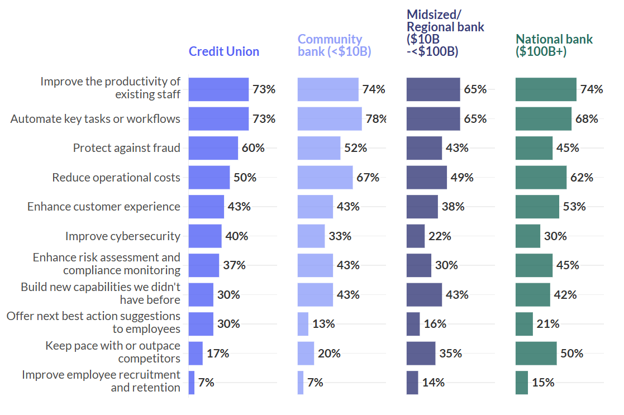
Looking at this graph, we can see a clear trend to improve the productivity of existing staff, emphasizing augmentation over outright replacement. Also, roles like fraud specialists, cybersecurity experts, risk assessment teams, and compliance managers are already being impacted by AI. Beyond what’s listed above, we can expect a reduction in the number of software developers and customer service agents as AI agents handle major portions of their workload.
Beyond that, financial industry experts envision alternative paths. Jamie Dimon, Chairman of the Board and Chief Executive Officer at JPMorgan Chase, says, “we will be hiring more AI people and fewer bankers in certain categories, and it will make them more productive.” His vision for the future financial workforce will be AI-savvy and know how to train models and create prompts that yield better results.
Bank of America provides a perfect example of this future. They recently launched an internal AI-powered advisory platform that will handle client queries and prepare recommendations autonomously of human employees. The technology is moving beyond chatbots and productivity tools to solutions that can handle complex work.
On the other hand, David Solomon, Chairman of the Board and Chief Executive Officer at Goldman Sachs, sees AI as a path towards more people-centric roles, resulting in “fewer people in regulatory reporting or client onboarding, freeing us up to hire more bankers, traders and asset managers who are interacting with clients constantly.” His vision involves a greater emphasis on creating a personal touch and connecting with customers to uncover the products and services they need.
The reality will likely be a combination of:
- Deep domain expertise. As we’ve seen in practice, AI outputs are only as useful as the humans who can interpret them, pressure-test them, and apply them with sound judgment in real client situations.
- Working fluency with AI. Institutions don’t always need professionals who can build models from scratch, but workers will need to know how to prompt them effectively and critically evaluate their outputs to recognize where they fall short.
- Strong interpersonal skills. The human moments will matter more as AI saturates every function, making trust-building and emotional intelligence bigger differentiators than ever.
Institutions that thrive in the future will be able to attract and retain talent who embody this rare combination of traits. As companies refine their workforce criteria, the market will see more intense competition for seasoned experts with deep domain expertise, genuine AI fluency, and the interpersonal gravitas to inspire client confidence.
Cultivating Tomorrow’s Financial Services Experts
Maybe more than eliminating entire functions, the biggest risk to the financial services sector is the erosion of entry-level pipelines.
A Harvard University study, after evaluating U.S. resume data from 65 million workers at 281,000 firms, found a “pronounced decline in junior employment, while senior employment trends remain unchanged.” Many junior roles have historically served as a training ground, helping workers gain experience with “routine but cognitively demanding activities.”
Debugging code, conducting routine KYC analysis, and conducting cybersecurity tests gave entry-level professionals the first-hand experience in processes and workflows that help them provide strategic value as they move up the career ladder. If AI absorbs that layer of work, institutions need to ask a harder question: how can they cultivate the early-career professionals to build expertise if the traditional on-ramp no longer exists?
If the traditional on-ramp no longer exists, financial institutions will need to build new ones. That means rethinking how expertise is developed from the ground up, rather than assuming it will emerge organically through years of routine work.
Some institutions are already experimenting with structured rotational programs that pair junior employees with senior mentors, giving early-career professionals exposure to high-stakes decisions and client interactions they would have previously worked toward over many years. Others are investing in AI-augmented learning environments where junior staff can observe and critique AI outputs as a way of building judgment, even when they aren’t performing the underlying tasks themselves.
The most forward-thinking organizations are also expanding their definition of entry-level value. A recent hire who can’t yet lead a client relationship can still contribute meaningfully by stress-testing model outputs, flagging edge cases that AI systems miss, and bringing fresh perspectives to how AI tools are used in practice. Building a culture that recognizes and rewards that kind of contribution creates a pathway for junior talent to grow while still serving the institution’s evolving needs.
Ultimately, the institutions that will sustain a competitive advantage are those that treat talent development as a continuous investment rather than an onboarding checkbox. The senior experts who will define the next decade of financial services are in the workforce today, many of them early in their careers. Whether they reach their potential within a given institution will depend on the deliberate choices leaders make now about how to cultivate, challenge, and retain them.
Ready to build a workforce that’s prepared for the future of financial services? Discover how our Talent Solutions can help you attract, develop, and retain the experts your institution needs.
Explore our workforce solutions
Banking Workforce of Tomorrow FAQs
Q: How is AI impacting jobs in banking and financial services? A: AI is affecting every function in banking, from front-office to back-office. While many institutions are using AI to augment existing staff productivity, some roles (including software developers, customer service agents, and compliance managers) are seeing reductions as automation handles more of their core responsibilities.
Q: Which skills will be most valuable in the future of banking? A: The most in-demand banking professionals will combine three key traits: deep domain expertise, working fluency with AI tools, and strong interpersonal skills. As AI handles more routine tasks, the ability to interpret AI outputs, build client trust, and apply sound judgment will become the defining differentiators.
Q: Are banks reducing their workforce because of AI? A: Yes, and it’s a global trend. Banks across the US, UK, India, Germany, and Vietnam are reducing headcount while making significant multi-year investments in AI. Three of the largest US banks have already projected workforce reductions, even as some CEOs believe AI will ultimately maintain or grow overall employment.
Q: How will AI affect entry-level jobs in financial services? A: AI is absorbing many of the routine but skill-building tasks that have historically served as training grounds for junior professionals. This is eroding the traditional career on-ramp, making it harder for early-career employees to develop the expertise needed to advance.
Q: How are financial institutions preparing their workforce for an AI-driven future? A: Forward-thinking institutions are experimenting with structured rotational programs, senior mentorship, and AI-augmented learning environments to develop junior talent. They are also redefining entry-level value by tasking new hires with stress-testing AI outputs and identifying gaps that automated systems miss.
Q: Will AI replace bankers entirely? A: Most industry leaders don’t foresee full replacement. JPMorgan Chase’s Jamie Dimon envisions hiring more AI-savvy professionals while reducing certain traditional banking roles. Goldman Sachs’ David Solomon sees AI freeing up staff for more client-facing, relationship-driven work. The consensus is that AI will transform roles rather than eliminate the need for human judgment entirely.